
Specialist placed
Performed by a board certified periodontist.
A dental implant replaces a missing tooth from the root up, anchoring a new tooth in the jawbone much like a natural one.
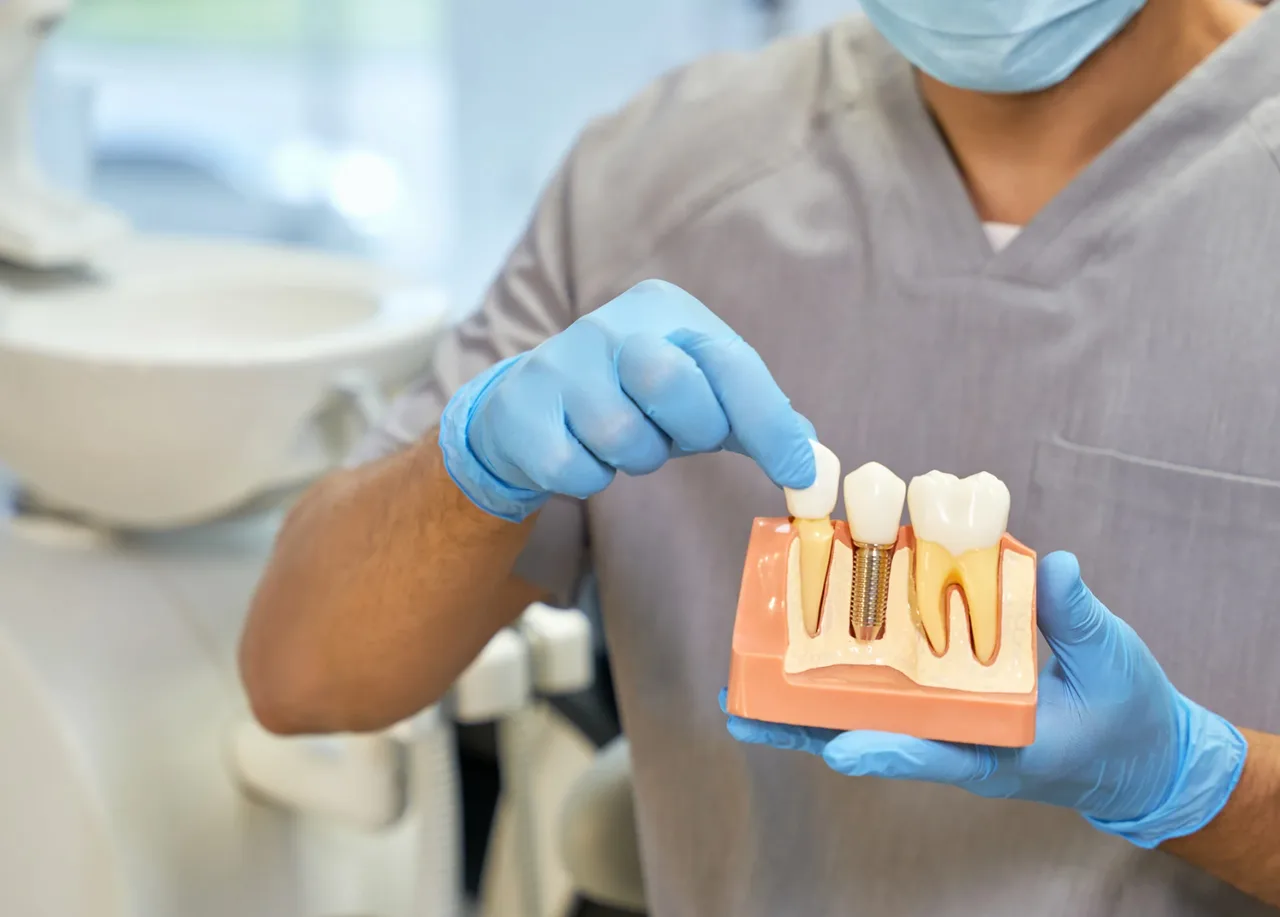
Our board certified periodontist places implants to replicate the natural tooth root, restoring full function and a result that blends in completely.
For patients who prefer metal free care, we offer ceramic implant options as part of our holistic approach.
Dental implants, also known as tooth implants, are considered a strong, long lasting option for patients with lost or missing teeth. Some dentists refer implant patients to an outside surgeon. At our Beverly Hills practice, implant care stays under one roof. Below, we answer the questions patients ask most about dental implants and the porcelain crowns that sit on top of them.

A dental implant replaces a tooth that is lost or missing. Each implant has two parts: a replacement tooth, and a biocompatible root that is anchored in the bone, just like a natural tooth. The root is traditionally made of titanium, and ceramic is available if you prefer a metal free option. Implants can replace one or two missing teeth, an entire arch of teeth, or even an entire smile. They are usually considered part of the cosmetic dentistry family, though they restore function as much as appearance.
An implant gives a new tooth a strong foundation in the jawbone. When a tooth is lost and its root is not replaced, the jawbone where it sat begins to sink and shrink. This is known as bone resorption, and over time it can change the shape of your face and make you look older. Dentures tend to loosen as the jawbone shrinks and the gums recede. Because an implant replaces the root as well as the tooth, it lets you bite, chew, and smile with a tooth that is fixed in place. For the fullest result, implants may be combined with other restorative treatments.
An implant can hold a single tooth, called a crown, or support several teeth together, called a bridge. When several teeth are missing, the bridge is customized to the shape of your jaw and smile. As a general guide:
If you are replacing several teeth, you can choose between a fixed bridge and a hybrid bridge that snaps onto the implant abutments, the connectors that sit on top of each implant.

All-on-4 restores a full arch of teeth on four implants, and in many cases the new teeth can be placed in a single day. It is often a good fit for patients whose smiles have been worn down by gum disease, broken fillings, and a bad bite, and for whom restoring every tooth one at a time is not practical. Like full mouth rehabilitation, it is a reorganized approach: rather than repairing failing teeth again and again, it gives you a new foundation for the teeth and smile you want.
The main advantages are efficiency and simplicity. Treatment can often be completed in one day, and it offers a way off the cycle of teeth that keep failing and need repair after repair. Whether All-on-4 is right for you is something we assess carefully at your consultation.
It depends on your case. In many cases an implant can be placed in a single visit: we place the implant root and, when it is suitable, attach a temporary tooth on top the same day. We call this Teeth in a Day. Your final crown or bridge follows once the bone has healed.
Healing often takes a few months, and it varies from person to person. During that time you can wear a natural looking temporary tooth. Beneath it, a process called osseointegration takes place: the bone grows around the new root until the two become one. Once the bone has healed, we attach an abutment to the implant and place your crown or bridge over it.
Care for your implants much as you would your natural teeth: brush and floss regularly, avoid very hard foods, and follow the care instructions we give you. After placement you will go home with written instructions for the healing period, and following them closely helps your implants heal well. For more on day to day care, see our article on maintaining your implants.
We do everything we can to keep implant treatment comfortable. Many of our patients have little discomfort after the procedure. Most implant procedures can be done with a local anesthetic, and we also offer different levels of sedation, including oral and IV sedation, if you feel anxious. If you are concerned about soreness afterward, we can prescribe pain medication.
The main risk is that the bone does not bond with the implant, the artificial root placed in the jaw. We take every precaution to reduce that chance, such as building up the jawbone first when needed and placing each implant at the precise depth for strong integration. A bacterial infection at the time of placement can also raise the risk of failure, which is why antibiotics are prescribed after placement. Implant failure is uncommon, and we will talk through your own risk factors before treatment.
There is no fixed lifespan for an implant. How long yours lasts depends on how well it integrates with the jawbone, the health of the bone around it over time, avoiding infection, and how well you care for it at home and keep up with regular visits. With good care, implants are designed as a long term way to replace teeth.
Once an implant has integrated with the jawbone, we do not usually expect to replace it. Osseointegration is the healing process in which healthy bone grows around the implant post. After that, chewing sends vibrations through the implant just as it would through a natural root, and those vibrations stimulate the jawbone. With that process working as it should, an implant is designed to stay intact and functional for many years. Bone loss is always something we watch for.
Coverage for dental implants varies from plan to plan, so we encourage you to contact your insurance company directly. Some plans extend benefits to certain parts of the treatment, such as the crown, bridge, or denture that sits on the implants, even when the implant posts and surgery are not covered.
The details that turn a procedure into a result worth keeping.
Performed by a board certified periodontist.
A long term answer, not a temporary patch.
Biocompatible ceramic implants are available.
Care at Perfect White Smile is rarely a single procedure. These often work alongside dental implants.
Sit with Dr. Frey for a private consultation. We will look at your teeth, gums, and jawbone and explain which implant options suit you.
Accessibility