TMJ Pain Treated: The Dentist’s Two-Phase Approach to Relieving Jaw Pain and Headaches

Temporomandibular joint problems, or more commonly known as TMJ, are among the most complex conditions dentists encounter. Patients have persistent headaches, jaw pain, facial tension, neck pain, or difficulty chewing. Many have already seen multiple healthcare providers before they reach a dental office that focuses on TMJ.
A structured treatment strategy can help bring clarity to these cases. One effective approach is a two-phase treatment model that focuses on stabilizing the patient and relieving pain, followed by correcting the underlying bite issue.
This approach was discussed in an educational presentation at UCLA by Dr. David Frey, DDS of Perfect White Smile Cosmetic Dentistry in Beverly Hills, who emphasized that TMJ care should focus on restoring harmony between the muscles, jaw joint, and bite.
When these systems function properly, patients often experience significant relief from headaches, jaw tension, and facial pain.
The Bite–Muscle–Joint Relationship
Many dentists begin thinking about TMJ when patients complain of jaw clicking or limited opening. TMJ patients often have a broader symptom profile.
Common complaints include:
- Chronic headaches
- Neck and shoulder tension and pain
- Facial muscle fatigue
- Jaw clicking or popping
- Difficulty chewing
- Ear pressure or ringing
- Grinding and Clenching of the teeth
Over time, dentists who focus on occlusion often notice an interesting pattern. When a patient’s bite is restored, many symptoms beyond the teeth begin to improve.
Patients frequently report that headaches become less frequent, neck discomfort improves, and chewing feels natural.
This observation highlights an important principle: a physiologically balanced bite supports the health of the entire jaw system.
A Functional View of TMJ
There are multiple theories about what causes TMJ. Some models emphasize psychosocial factors such as stress or emotional health. While these elements can influence symptoms, many dentists approach TMJ from a functional perspective.
In this framework, TMJ problems occur when three systems lose balance:
- The bite
- The jaw joint
- The muscles of mastication
When these elements function together, the jaw moves comfortably. When they fall out of alignment, muscle tension increases and the joint may become overloaded.
The goal of treatment is therefore to reestablish harmony between the bite, muscles, and joint.
Phase One: Stabilizing the Patient and Relieving Pain
The first phase of TMJ treatment focuses on helping the patient become comfortable again. The great aspect of Phase 1 therapy is that it is completely reversible, meaning that if it does not solve the problem, the patient is still in the same state that it started in. Many times, a patient will present with TMJ type symptoms and the dentist may start orthodontic treatment without solving the TMJ problem first. Orthodontics is not reversible and would be considered a Phase 2 treatment. This is an important point because the dentist may make the TMJ symptoms worse if not dealt with prior to doing orthodontics.
Many TMJ patients have symptoms severe enough to disrupt daily life. Some struggle to chew normally, while others experience constant headaches or facial pain.
Phase one treatment aims to:
- Reduce muscle tension
- Decompress the jaw joint
- Stabilize the bite position
- Relieve pain and inflammation
This phase typically involves orthotic therapy, where an appliance is used to guide the jaw into a more natural position.
When the jaw is supported in a healthier alignment, the muscles surrounding the joint can begin to relax and adapt. As the muscles calm down, symptoms such as jaw clicking, headaches, and muscle fatigue improve.
Phase one treatment generally lasts up to three months, although this varies depending on the patient and severity of symptoms.
Why Orthotics Must Be Functional
Many patients seeking TMJ care already have a night guard. In fact, some patients arrive with appliances they have worn for many years.
While night guards can protect teeth from grinding, they do not always address the underlying problem if they are only worn during sleep.
A useful analogy involves knee injuries.If a patient with a knee injury wears a brace only while sleeping but removes it during the day and continues running, the knee would have difficulty healing.
The same concept applies to the jaw.
If the orthotic positions the jaw correctly but the patient removes it whenever they eat, the jaw may return to the same stressful position that caused the problem in the first place.
For this reason, many TMJ clinicians prefer functional orthotics that allow patients to chew while maintaining the corrected jaw position.
Phase Two: Stabilizing the Bite
Once the patient becomes comfortable and the jaw stabilizes, treatment may move into phase two.
This phase focuses on aligning the teeth with the new healthy jaw position created during the first phase.
Without phase two, some patients may remain dependent on an orthotic appliance indefinitely.
Instead, dentists may recommend bringing the teeth into the alignment of the successful orthotic use through:
- Orthodontic treatment
- Invisalign therapy
- Restorative dentistry
- Full-mouth rehabilitation
By moving the teeth into the correct position, the bite can permanently support the jaw joint and surrounding muscles indefinitely. Phase 1 finds this correct position first and then the teeth are permanently positioned in Phase 2 with restorations or orthodontics.
Not every patient requires extensive treatment, but phase two provides an option for long-term stability beyond appliance therapy.
The Importance of Detailed Diagnosis
Accurate diagnosis plays a critical role in TMJ treatment.
A thorough patient history is often the starting point. Dentists ask detailed questions about symptoms, including:
- Frequency of headaches
- Duration of pain episodes
- Severity of symptoms
- Previous treatments
Some clinicians use diagnostic questionnaires to gather information. These forms help reveal patterns that may not be spotted during a routine exam.
The Role of Advanced Imaging
Modern imaging technologies provide valuable insight into TMJ cases.
CT Scans
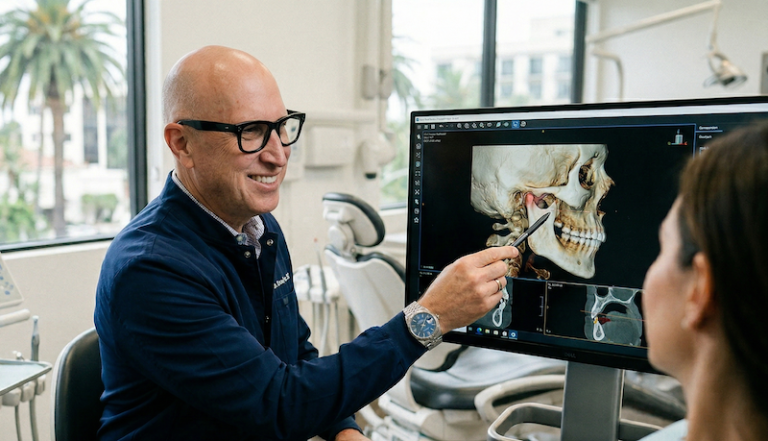
Cone beam CT scans allow dentists to visualize structures that cannot be seen with traditional dental X-rays.
CT imaging can reveal:
- The position of the jaw joints
- Sinus anatomy
- Airway space
- Tongue posture
- Signs of clenching or grinding
For example, gonial notching may indicate long-term clenching forces.
Airway evaluation is also important because sleep occupies nearly one-third of a person’s life. Breathing patterns and tongue posture can influence jaw function and muscle activity.
Evaluating Muscle Activity
Another key part of TMJ diagnosis involves understanding how the jaw muscles function.
The mandible is supported by four primary muscles:
- Temporalis muscles
- Masseter muscles
- Medial pterygoids
- Lateral pterygoids
These muscles act like a supporting sling for the lower jaw.
Because the jaw is not rigidly attached to the skull, muscle activity plays a major role in determining jaw position.
Evaluating muscle activity through diagnostic tools such as electromyography can help dentists understand whether the muscles are functioning in balance or under strain.
If muscle tension is excessive, it may signal that the bite position is forcing the jaw into an unhealthy position.
A Comprehensive Approach to TMJ Care
TMJ treatment requires research and a systematic approach.
Dentists must evaluate the patient’s symptoms, medical history, muscle activity, joint structure, and bite alignment before developing a treatment plan.
When diagnosis is thorough and treatment follows a structured two-phase model, many patients experience meaningful improvements in comfort and function.
Restoring Balance to the Jaw System
The ultimate goal of TMJ treatment is not just to eliminate symptoms. It is about restoring harmony between the bite, jaw joint, and muscles.
The two-phase treatment model provides a practical pathway toward that goal.
Phase one focuses on relieving pain and stabilizing the patient.
Phase two aligns the teeth to support the corrected jaw position that was found in Phase 1.
When these steps are applied carefully, dentists can help many patients find lasting relief from TMJ-related pain and regain comfortable function in their daily lives.